
The Complete Guide to Aquarium Filtration and Filter Media: Stop Wasting Money and First Understand “Building Homes for Nitrifying Bacteria”
Update time: 26-10-26 Views: 12
When you first get into the aquarium hobby, the easiest mistake to make is equating filtration with “making the water clear.” So you buy the most expensive filter media, pack the filter compartment to the brim—and the water still turns cloudy, and the fish still get sick. The problem is often not how much money you spent, but that you haven’t grasped one thing: the primary customer of a filtration system is the nitrifying bacteria, and only secondarily your eyes.
Whether the water looks clear depends on mechanical filtration trapping suspended particles. Whether the fish can live well depends on that invisible community of nitrifying bacteria in biological filtration, which converts the highly toxic ammonia and nitrite produced by fish waste, step by step, into nitrate, which is far less toxic. A filter compartment is essentially not a “Water Purifier,” but a “residence” designed for nitrifying bacteria. Filter media selection, placement order, and routine maintenance should all revolve around this logic.
I. Three Types of Filtration, Each with Its Own Job
A complete filtration system usually contains three layers, but not every tank needs all of them.
Mechanical filtration is the first line of defense. Its task is to intercept visible suspended matter such as fish feces and leftover food. Representative media include filter pads and filter fleece. Whether mechanical filtration is done well directly determines whether the biological media behind it will get clogged by dirt.
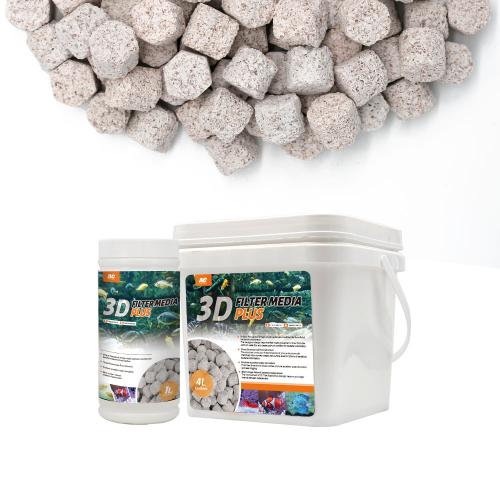
Biological filtration is the core of the system and is responsible for breaking down toxins. Porous materials such as ceramic rings, bacteria houses, quartz bio-balls, and bio-sponges provide attachment surface area for nitrifying bacteria. The higher the porosity and the larger the specific surface area of the media, the more bacteria it can host, and the stronger its biological processing capacity.
Chemical filtration is a “special forces” unit, not the daily main force. Activated carbon adsorbs pigments and medication residues, zeolite emergency-adsorbs ammonia nitrogen, and maifan stone slowly releases minerals. They have clear applicable scenarios, but also saturation cycles and side effects. Used incorrectly, they can actually cause trouble.
II. How to Choose a Filtration System: Match the Tank, Not the Budget
There is no “best” filter, only the “most suitable” one. The core variables that determine your choice are only three: tank size, the waste output of your fish, and your tolerance for noise and aesthetics.
Hang-on-back (HOB) filters are suitable for micro tanks under 30 cm, housing three to five guppies or neon tetras. They are cheap, quiet, and easy to install, but their media space is extremely small and their filtration capacity is limited. Do not expect them to handle higher stocking densities.
Overhead trickle filters (drip trays) are the best value choice for medium tanks of 40–80 cm. A pump pushes water up to the top filter box, where it trickles down layer by layer. They offer high filtration efficiency, good oxygenation, and easy cleaning, and are especially suitable for fish that “eat a lot and poop a lot,” such as goldfish and parrot cichlids. The cost is an extra box on top of the tank and a slightly louder water sound.
Canister filters are standard equipment for planted-tank hobbyists. The sealed canister takes up no space inside the tank, is quiet, and can reduce CO2 escape. However, cleaning requires disassembling the canister, oxygenation is not as good as with trickle filters, and biological capacity may be tight when fish stocking density is high.
Sump filters are the ultimate solution for large tanks. The filter compartments are large, with dry-wet separation, all equipment hidden, and the most stable water quality. But they are expensive and structurally complex, suitable for players with tanks over 1 meter, keeping arowanas, koi, or high-density stocks—a one-step solution.
A simple decision order: first measure the tank, then look at the fish, and finally look at the budget. It is better for filtration to be slightly stronger than needed than to sit right at the critical point—fish will grow, and waste output will increase.
III. How to Choose Filter Media: Don’t Worship “Advanced”; Understand Function First
The names of filter media on the market are dazzling, but if you sort them by function, there are only a few categories.
Filter pads (white cotton/filter fleece/filter wool) are purely mechanical consumables responsible for catching dirt. Their destiny is to get dirty, be washed, fall apart, and be replaced. There is no need to pursue “lifetime use.” White cotton is cheap but falls apart after a few washes; filter fleece and filter wool are more durable and offer higher interception precision.
Bio-sponges sit between mechanical and biological filtration. Their pores are larger than those of filter pads. They can block some fine debris and also allow bacteria to attach. They are reusable and suitable as a buffer transition layer between the mechanical layer and sintered biological media.
Ceramic rings are the most classic sintered biological media: cheap, with good water permeability, suitable for filling filter compartments in large quantities. The drawback is uneven quality; inferior products tend to powder and shed slag. When purchasing, prioritize products that are hard and do not shed powder.
Quartz balls/nano balls follow the “small volume, high specific surface area” route. Their pores are fine and dense, and their bacterial density per unit volume is high. They are suitable for space-constrained scenarios such as canister filters and small filter compartments. They usually cost more than ordinary ceramic rings but offer better hardness and stability.
Bacteria houses are large in volume with large pores, and theoretically have high bacterial culture efficiency. But they have a severely underestimated prerequisite: they need sufficient water flow to pass through their interior. In small canister filters, HOB filters, or filter compartments with weak flow, most of the interior space of large bacteria houses may not come into contact with oxygenated water at all. Their bacterial culture effect may even be worse than small ceramic rings, and they easily become dead spots for dirt accumulation. They are better suited to sumps and large trickle boxes with abundant flow and ample space.
Activated carbon and zeolite are functional, not permanent residents. After activated carbon reaches saturation, it loses effectiveness and may even release adsorbed substances back; zeolite also has a saturation limit for ammonia adsorption. They are suitable for temporary scenarios such as starting a new tank, adsorbing residues after medication, or yellowing water. Remove or replace them promptly after use, rather than leaving them in the filter compartment permanently.
IV. The Golden Rule of Placement: Follow the Water Flow, Mechanical First, Biological Second
There is only one core principle for filter media placement: whichever medium the water passes through first should handle the corresponding job first. The correct order is always from the inlet end to the outlet end: mechanical filtration → biological filtration → (optional) chemical/functional filtration.
If the order is reversed and biological media contact dirty water first, fish feces and leftover food will directly clog the micropores of ceramic rings and quartz balls. Nitrifying bacteria lose their habitat, water flow slows down, and the entire filtration system gradually fails.
Specifically for common equipment:
Canister filter: The inlet first meets filter fleece or coarse pads to catch large particles; the second layer is fine pads to catch small impurities; the third layer is bio-sponge as a buffer; toward the outlet, fill with ceramic rings and quartz balls as the biological core.
Overhead/trickle filter: The top layer is filter fleece to catch large impurities, making it easy to remove and rinse daily; the middle layer is fine pads plus bio-sponge to refine filtration and begin bacterial cultivation; the bottom layer holds ceramic rings or quartz balls, allowing the highly oxygenated water from the trickle to pass fully through.
Sump: The first chamber is white pads plus filter fleece for full mechanical interception; the second chamber is bio-sponge plus ceramic rings as a transition; the third chamber is bacteria houses or quartz balls as the main bacterial cultivation area; the pump chamber holds only equipment, no filter media.
There is also an easily overlooked detail: do not pack the filter media too tightly. Water needs to pass through the interior of the media, not just flow around the surface. Packing it too full causes “flow short-circuiting,” and a large amount of media does not actually participate in filtration—meaning it is as good as not being there.
V. Maintenance: Less Fiddling Is the Best Care
What a filtration system fears most is often not “being dirty,” but “being too clean.”
Mechanical filter pads need frequent maintenance: wash them when dirty, replace them when worn out. Gently press and rinse them in old tank water from a water change. Do not blast them with tap water, and never use detergent.
Biological media is the opposite: it does not need frequent washing. As long as mechanical filtration is in place, biological media can remain untouched for several months or even more than half a year. When cleaning, gently rinse it with original tank water and preserve the yellowish-brown biofilm on the surface. Never scrub it until it is “snow-white and clean.”
Replacing filter media should be done in batches. Replacing all old media at once is equivalent to resetting the nitrification system to zero, and water quality will fluctuate violently within a few days. Replace only a portion each time, keeping at least one-third of the old media together with the new media for several weeks, so the bacterial community has time to transfer and rebuild.
There is also a bottom line: do not shut down the filtration system arbitrarily. Nitrifying bacteria are aerobic bacteria, and a power outage of several hours can cause massive die-off. Turning off the pump at night because it is noisy is one of the common triggers for water quality collapse.
In the end, aquarium filtration is not that mysterious. Do mechanical interception solidly, leave enough porous space with water flow and not clogged by dirt for nitrifying bacteria, and then restrain your hands and fiddle less—water quality will naturally reward you. The most expensive filter media is not necessarily the best; media placed in the right position and used in the right scenario are the ones actually doing the work.