Cloudy Water, Lethargic Fish? The Problem May Be Your Filter Media
Update time: 26-09-09 Views: 11
Every aquarist has been there: you did a water change just days ago, yet the tank is turning cloudy again. Your fish are clamping their fins, gasping at the surface, and a quick test confirms the worst — spiking ammonia and nitrite. The instinctive response is another water change, but frequent water changes only treat the symptom. What truly keeps aquarium water stable over the long run is the nitrification system hidden inside your filter — and the foundation of that system is a quality biological filter media.
First, Understand Why Your Tank Depends on "Good Bacteria"
An aquarium is a closed, miniature ecosystem. Fish waste, uneaten food, and decaying plant matter break down into highly toxic ammonia (NH₃/NH₄⁺), which is then converted into equally dangerous nitrite (NO₂⁻). Even small concentrations of either can stress fish, suppress their appetite, or worse.
Fortunately, nature provides a cleanup crew: nitrifying bacteria. These beneficial bacteria colonize solid surfaces and convert ammonia into nitrite, then into far less toxic nitrate, which is removed through water changes or absorbed by live plants. This chain — ammonia → nitrite → nitrate — is the nitrification system.
Here's the key: nitrifying bacteria are sessile organisms. They must attach to a solid surface to multiply. That means filter media is more than a physical barrier that traps debris — it is an apartment building for beneficial bacteria. The pore structure and surface area of your media directly determine how many bacteria your tank can support, and how stable your water can be.
Three Common Problems with Traditional Filter Media
Many aquarists using conventional ceramic or glass rings eventually run into the same old issues:
1. Crumbling and dust. Some media are poorly sintered and lack hardness. After six months to a year, they begin to disintegrate, shedding fine debris that clogs the filter chamber, drastically reducing colonization area — and the particles can even wash back into the tank and cloud the water.
2. Heavy and bulky. Traditional ceramic media is dense; a single box can weigh several kilograms. It is exhausting to lift out for cleaning, and its bulk eats up valuable space in your filter — meaning less media in the same-sized chamber.
3. Poor water flow. Densely packed media easily creates "dead zones," where water takes the path of least resistance. Portions of the media never contact oxygen-rich water, nitrifying bacteria fail to colonize, and filtration efficiency suffers.
AC Sintered Glass Ring Plus: Engineered to Solve Them All
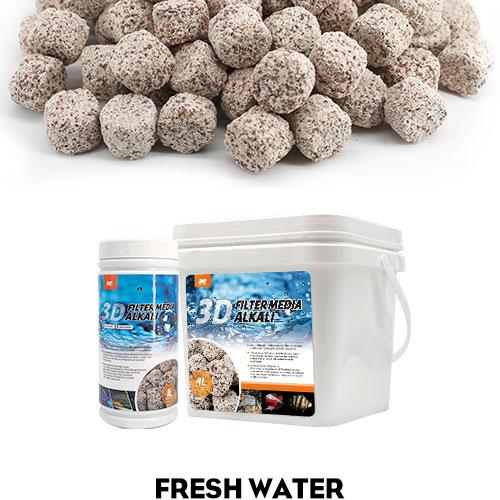
To address these pain points, AC has completely upgraded the classic ceramic ring and introduced the Sintered Glass Ring Plus — a neutral mineral-based media suitable for both freshwater and marine aquariums. It releases no harmful substances and remains stable in both acidic and alkaline conditions. Compared to the previous generation, it delivers three major upgrades:
① 38% Lighter — No More Heavy Lifting
Thanks to an innovative manufacturing process, the Sintered Glass Ring Plus achieves a 38% weight reduction: while the previous generation weighed about 580 g per liter, the new version weighs only around 360 g per liter. Cleaning, replacing, and transporting your media is now effortless. Best of all, the lightweight design sacrifices nothing in chamber capacity — the same filter volume now holds even more media, delivering both convenience and superior filtration efficiency.
② Doubled Hardness — No More Crumbling
Lab tests speak for themselves: the previous generation measured a hardness of 54.1, while the upgraded version reaches 118.7 — more than double. This superior hardness means the rings stay intact without powdering or shedding debris, even after long-term submersion. The result is a significantly longer service life and no more tedious cleanups of crumbled residue.
③ 3D Interconnected Pores — Double Efficiency in Cultivation & Filtration
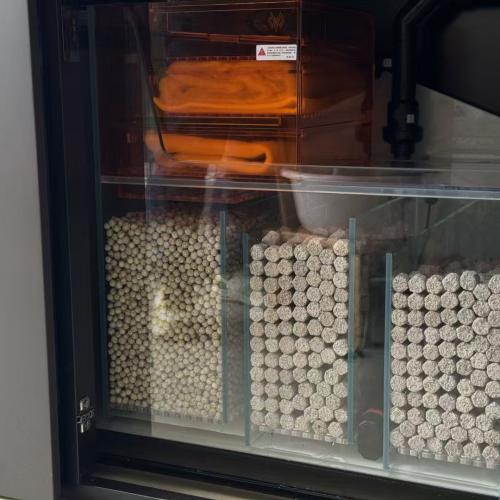
The Sintered Glass Ring Plus features an optimized internal pore structure that forms a three-dimensional interconnected pore network. These developed pores work in two ways: on one hand, they efficiently trap fine suspended particles for effective mechanical filtration; on the other, they provide abundant colonization space for nitrifying bacteria and other beneficial microbes — helping your aquarium establish a nitrification system quickly and steadily reduce ammonia and nitrite.
④ Classic Ring Design — Breaks Up Water Flow, Never Clogs
The ring shape is a time-tested design in filtration equipment: the central channel lets water pass through rapidly, breaking up flow and eliminating dead zones. With excellent permeability and resistance to clogging, filtration stays thorough while operating noise is reduced. The compact, uniform rings can be arranged flexibly and fit sumps, trickle (drip) filters, hang-on-back filters, canister filters, and more — from desktop nano tanks to large display aquariums.
Specifications
Item
Details
Product Name
Sintered Glass Ring Plus
Package Sizes
4L/drum
Main Function
Cultivates nitrifying bacteria; reduces ammonia and nitrite
Applications
Sump, trickle filter, HOB filter, canister filter, etc.
Suitable Water
Freshwater / Marine; neutral mineral media
Pro Tips for Best Results
- Cycling a new tank: Add a bacteria starter to speed things up — the rings provide the colonization surface. A stable nitrification system typically establishes in 2–4 weeks.
- Media placement: Ensure even water distribution across the media; avoid over-compacting to keep pores open and flowing.
- Cleaning & maintenance: Gently rinse the rings in tank water only. Never blast them with tap water, or you'll kill the nitrifying bacteria colony.
- Upgrading old media: Replace media in batches, keeping some old rings in place to preserve the bacterial colony and avoid water quality swings.
Stable water is the top priority in fishkeeping — and stable water is built on a powerful nitrification system. Choosing a lightweight, high-hardness, richly porous media gives your tank's "self-purification capacity" a solid foundation. The AC Sintered Glass Ring Plus lets the numbers do the talking: 38% lighter, hardness of 118.7, and a 3D interconnected pore network — for more efficient bacterial cultivation and easier maintenance.
Related News